AI Advancements in India 2026: How India Is Building Its Own AI Models
From BharatGen to Sarvam AI, India is building sovereign AI models for 22 languages. Here is everything you need to know about India's LLM revolution.
PP
Pulkit Porwal
Mar 15, 2026•8 min read

On this page
Key Takeaways
- India launched the IndiaAI Mission in 2024 with ₹10,372 crore in funding to build sovereign AI models.
- BharatGen, led by IIT Bombay, is India's first government-funded multimodal LLM targeting 1 trillion parameters across 22 Indian languages.
- Sarvam AI launched two models in February 2026 — a 30B speech model and a 105B reasoning model — both covering 22 Indian languages.
- By March 2026, 67 proposals were received under the IndiaAI Mission, with 22 specifically for LLMs and multimodal models.
- Private companies like Tech Mahindra and Fractal Analytics are also developing trillion-parameter sovereign LLMs.
- India's local AI tools have already helped reduce reliance on foreign APIs by 33%.
- Five sovereign AI models were officially launched at the India AI Impact Summit 2026.
- The Bharat Data Sagar dataset has over 15,000 hours of voice data — the world's largest India-centric dataset.
I have been following the AI space for years, and I have to say — what is happening in India right now is one of the most exciting things I have ever seen. When I first heard about BharatGen and the IndiaAI Mission, I was genuinely surprised by how fast things were moving. India is not just trying to use foreign AI models anymore. It is building its own.
In this article, I am going to walk you through everything you need to know about AI advancements in India — from government-backed projects to private companies building trillion-parameter models. I will explain it all in simple words, so even if you are new to AI, you will understand exactly what is going on and why it matters.
1. What Is the IndiaAI Mission and Why Does It Matter?
The IndiaAI Mission was launched in 2024 with a budget of ₹10,372 crore (roughly $1.25 billion). That is a huge amount of money, and it tells you just how serious the Indian government is about building its own artificial intelligence. The mission's main goal is to create AI models that work specifically for Indian languages, Indian problems, and Indian people.
What makes this different from, say, ChatGPT or Google Gemini? Those models were built with mostly English-language data. They do not understand Hindi, Tamil, Marathi, or Telugu the same way a model trained on Indian language data would. The IndiaAI Mission wants to fix that. By mid-2026, over 67 proposals had been submitted to the mission, with 22 of them specifically focused on building large language models (LLMs). That is a lot of teams working on a very important problem.
If you want to understand how AI tools are being used in business more broadly, check out this article on the best AI agent tools for enterprise.

2. BharatGen: India's First Government-Funded Multimodal AI Model
One of the most impressive projects to come out of the IndiaAI Mission is BharatGen. This project is led by IIT Bombay and includes partners like IIT Madras and IIIT Hyderabad. BharatGen is India's first government-funded multimodal large language model, which means it can understand and generate text, speech, and images — all in Indian languages.
The target for BharatGen is a 1-trillion-parameter "mother model" to be completed by mid-2026. Think of parameters like the brain cells of an AI model — more parameters usually means a smarter and more capable AI. Once the mother model is ready, it will be broken down into smaller, specialized versions for sectors like agriculture, healthcare, and governance.
What I find personally exciting is the Bharat Data Sagar dataset that BharatGen is building. It is described as the world's largest India-centric dataset, with more than 15,000 hours of voice data. That kind of data is what makes AI actually useful for Indian users. Pilots for BharatGen are already live in governance and farming as of early 2026, which is a great sign.
IBM is also collaborating with BharatGen to make the model more inclusive beyond just the most commonly spoken Indian languages — which is something I think a lot of people overlook when talking about Indian AI.
3. Sarvam AI: India's Homegrown Speech and Reasoning Models
In February 2026, Sarvam AI made a big announcement: they launched two sovereign AI models that I think deserve a lot more attention than they have been getting. The first is a 30-billion-parameter model built for real-time speech processing. The second is a massive 105-billion-parameter model for complex reasoning tasks. Both models support 22 Indian languages.
What impressed me the most when I looked at the data was that Sarvam AI's models outperform some global benchmarks when tested specifically on Indian data. That is a huge deal. It proves that a model built specifically for Indian language patterns and cultural context can beat models that were built with far more general data.
Sarvam AI's contribution to India's AI ecosystem is significant not just for technology reasons, but also because it shows that Indian startups can compete at the global level. Their work is a key part of why India was able to launch five sovereign AI models at the India AI Impact Summit 2026.

4. IIT Bombay's Role in India's AI Revolution
I want to spend a moment focusing specifically on IIT Bombay's role in India's AI story, because it is central to everything happening right now. IIT Bombay is not just leading BharatGen — it is acting as the anchor institution for one of the most ambitious AI research projects any country has ever funded. For an institution to take on a 1-trillion-parameter model is extraordinary.
IIT Bombay is working with a consortium that includes IIT Madras and IIIT Hyderabad. Each institution brings unique strengths. IIT Madras is well-known for its work in natural language processing and Tamil-language AI. IIIT Hyderabad has deep expertise in speech and language technologies.
What this tells me as someone who follows AI research is that India is taking a smart, distributed approach to building AI capabilities rather than relying on a single company or lab. That is actually what the best AI ecosystems in the world look like. For small businesses wanting to understand AI at a practical level, I recommend reading about the best AI tools for small businesses in 2026.

5. Private Companies Joining the Race: Tech Mahindra, Fractal Analytics, and More
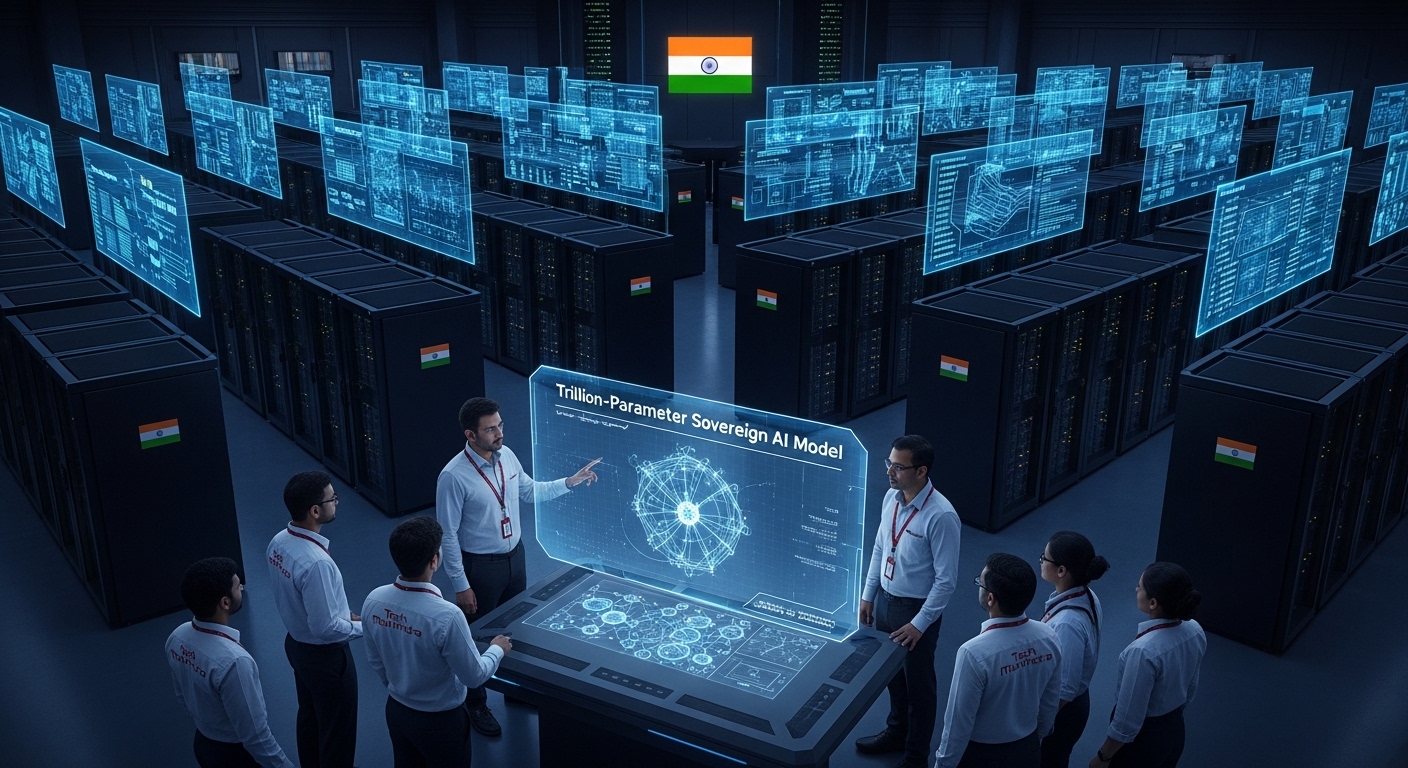
It is not just the government and academia building India's AI future. Private companies have jumped in too. Tech Mahindra and Fractal Analytics were both selected under the IndiaAI Mission to develop foundational large language models. Tech Mahindra is targeting a 1-trillion-parameter sovereign LLM, which would put them in the same league as the biggest AI labs in the world.
Other private players are also contributing. Companies like Q3 Technologies and Maruti Techlabs are offering custom LLM services for enterprise clients in India. Gnani.ai is contributing voice-focused models, which is especially important in a country where many people communicate verbally in regional languages rather than typing.
One thing I find really smart is that public-private partnerships are being used to pool compute resources for startups. Prime Minister Modi himself highlighted this approach. By pooling resources, India is removing that barrier and giving more people a chance to build.
Tools like Ollama are also helping Indian developers experiment locally with LLMs, which has already led to a 33% reduction in reliance on foreign APIs. That is a real, measurable sign of progress.
6. India's Major AI Players at a Glance (March 2026)
Here is a quick summary of the main entities building large language models in India as of March 2026. I find it helpful to see all of this in one place, because the pace of announcements has been fast and it can be hard to keep track.
| Entity | Model Focus | Parameters / Languages | Status |
| BharatGen (IIT Bombay) | Multimodal LLM (text, speech, vision) | 1 trillion target / 22 languages | Pilots live; full rollout mid-2026 |
| Sarvam AI | Speech & reasoning LLMs | 30B & 105B / 22 languages | Launched February 2026 |
| Tech Mahindra | Sovereign LLM | 1 trillion | In development |
| Fractal Analytics | Foundational LLM | TBD | Selected; progressing |
| Gnani.ai | Voice-focused models | N/A | Contributing to ecosystem |
This list only covers the biggest names. There are 12+ teams shortlisted under the IndiaAI Mission as of early 2026, with more likely to be added as the year progresses.
7. Why India Building Its Own AI Actually Matters for You
You might be wondering — why should I care about India building its own AI models? Even if you are not a developer or a researcher, this matters for a very simple reason: AI that understands your language and your context will be far more useful to you than AI that was built for someone else.
Think about a farmer in Maharashtra asking an AI chatbot about what pesticide to use for a specific crop problem. If the AI was trained mostly on English-language agricultural data from the United States, its answer might not apply to Indian crops, Indian weather, or Indian market conditions. But a model trained on Indian data, in Marathi, with Indian agricultural knowledge? That could genuinely change lives.
The same applies to healthcare. A model trained on Indian medical records and Indian disease patterns would give doctors and patients far better information than a general-purpose foreign model. BharatGen is already piloting exactly this kind of use case in governance and farming.
From a data sovereignty perspective, this is also important. When Indian users interact with foreign AI models, their data is processed on foreign servers. Building Indian AI means Indian data stays in India. If you use AI in your marketing workflow, you might also find value in these 7 prompts for marketing to get started.
8. What to Expect from India's AI Scene for the Rest of 2026
Based on everything I have seen so far, I believe the second half of 2026 will be a landmark period for AI in India. Here is what I am watching closely:
- BharatGen's full rollout is targeted for mid-2026. If the 1-trillion-parameter mother model is completed on schedule, it will be a historic milestone for Indian AI.
- All 22 Indian languages are expected to be covered by the IndiaAI Mission's models by mid-2026. Right now 15+ languages are supported, and expanding to the full 22 would be a major achievement.
- More private sector launches are likely. Tech Mahindra and Fractal Analytics are in development, and I expect at least one of them to announce a public model or pilot by year-end.
- More public-private compute partnerships will be announced, giving startups access to infrastructure without needing billions of dollars.
- International collaborations like the IBM-BharatGen partnership will likely expand, bringing global expertise into India's AI ecosystem while keeping the core models sovereign.
My personal take is that India is about 12–18 months away from having a genuinely competitive set of AI models that can rival what is available from OpenAI or Google in specific Indian-language tasks. If you want to get ahead of the curve and start using AI to generate income, I recommend reading about ChatGPT prompts to make money in 2026.
Having watched national AI programs in multiple countries, what stands out about India's approach is the combination of scale, diversity, and distribution. Most countries build one or two flagship AI labs. India is building a whole ecosystem — academic consortia, private companies, government funding, compute sharing, and data infrastructure — all at the same time. That is how you build something that lasts.
India's AI Models vs. Global Models: Key Differences
- Language coverage: Indian models cover 22 Indian languages; global models focus primarily on English and a handful of major world languages.
- Domain relevance: Indian models are trained on Indian agriculture, healthcare, and governance data; global models are more general-purpose.
- Data sovereignty: Indian models keep user data within India; foreign models process data on overseas servers.
- Cultural context: Indian models understand Indian names, places, festivals, idioms, and cultural references far better than foreign models.
- Cost: Local deployment via tools like Ollama reduces costs by 33% compared to calling foreign APIs.